On-Demand Consultants vs. Management Consulting Firms: What PE Operators Actually Get
On-Demand Consultants vs. Management Consulting Firms: What PE Operators Actually Get
When should a PE-backed company hire an on-demand consultant instead of a management consulting firm? Learn the key differences in cost, speed, expertise, and execution outcomes.
The Short Answer
What "On-Demand Consulting" Actually Means
What a Traditional Management Consulting Firm Engagement Looks Like
How the Two Models Compare
Cost, Where the Difference Actually Comes From
Speed and Time to Value
Who Actually Does the Work
Scope Control and Knowledge Transfer
On-Demand Consultant, Fractional Consultant, Independent Consultant, Marketplace: Sorting the Terms
When a Management Consulting Firm Is Still the Right Call
When On-Demand Wins
What Clients Ask For vs. What They Actually Need
Why On-Demand Engagements Underperform
How to Evaluate an On-Demand Consulting Partner
How ECA's On-Demand Model Works
Three Recent Engagements
The Short Answer
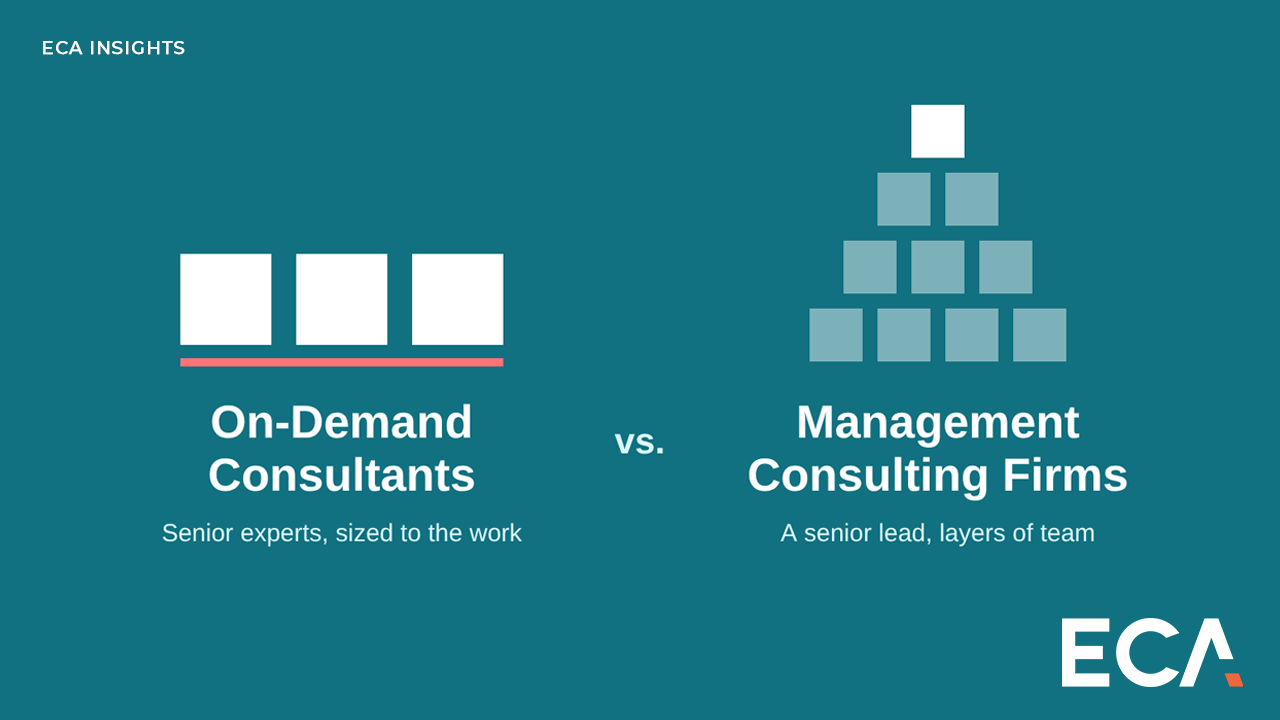
A traditional management consulting firm sells a team, a methodology, and institutional accountability. Its price covers a pyramid of leverage and a permanent bench. On-demand consulting sells access to individual senior operators, matched to a specific problem, priced without that overhead and scoped to end when the work ends. Neither model is categorically better. The right choice depends on whether the problem needs a team with a method or a person with judgment, whether the answer must be independently defensible to a third party, and how fast the work has to start.
A practical test: if you can name the person you need, use on-demand. If you can only name the capability you need, you may need a firm.
The rest of this article works through that test for private equity sponsors and portfolio company leaders, who buy both kinds of consulting and often buy them for the same asset.
Have a role you'd like to discuss?
Looking to expand your team?
What "On-Demand Consulting" Actually Means
The term is used loosely, so it is worth defining by its mechanics. A firm maintains a vetted network of independent senior consultants, typically strategy firm alumni, operating executives, and functional specialists. When a client has a defined project, the firm matches one consultant or a small group to it. The consultant works directly with the client for the length of the engagement. The intermediary handles sourcing, vetting, matching, contracting, and administration, then steps back out when the work is done.
That is the model behind ECA's on-demand consultants practice and behind most serious providers in the category. It is also called independent consulting, project-based consulting, or consulting on demand. The underlying structure is broadly the same.
Three adjacent models get confused with it:
- Staffing and contract labor. Staffing places capacity into an ongoing role. On-demand consulting places senior problem-solvers on defined projects. The distinction is scope and seniority.
- Open talent marketplaces. These are self-serve platforms where the client does the sourcing and vetting. Our research indicates that this approach often carries a failure rate above 75%. Moreover, a bad hire costs US businesses about $17,000 on average. When nobody verifies experience or availability, the business carries all of the selection risk with no recourse for a poor hire.
- Interim and fractional executives. This is the distinction readers most often miss. An interim executive holds a seat and carries line authority. They run the finance function, sign off on decisions, and manage the team until a permanent leader arrives. An on-demand consultant delivers a project and holds no seat. If you need someone to own a function, you need an interim. If you need someone to answer a question or complete a piece of work, you need a consultant.
What a Traditional Management Consulting Firm Engagement Looks Like
A firm engagement has a recognizable structure. A partner or principal owns the client relationship and the quality of the answer. A project leader runs the day-to-day. A team of associates and analysts does the analytical work. Behind them sit a defined methodology, a research and knowledge infrastructure, and firm-level accountability for the recommendation.
That structure buys real things:
- Analytical horsepower at scale
- The ability to run several workstreams at once
- Benchmark and industry data the client cannot assemble alone
- Independence and third-party credibility when a recommendation has to be defended to a board or a lender
- A named institution standing behind the answer
The training this model produces is also real. It is one reason former management consultants are regularly considered for CEO roles.
The trade-offs are just as structural. Cost is driven by the leverage model. The team learns the business on the client's clock, so there is ramp time. Who is actually assigned can vary. Scope is often structured in a way that can expand. And much of what the team learns leaves with them.
How the Two Models Compare
The two models differ significantly according to the following dimensions:
Dimension | Management consulting firm | On-demand consulting |
What you are buying | A team, a methodology, and institutional accountability | An individual senior operator matched to a defined problem |
Who does the work | Associates and analysts, directed by a project leader and a partner | The senior consultant who was matched to the project |
Typical time to start | Weeks: scoping, staffing availability, and contracting, then a team ramp | Days to a few weeks: a shortlist in days, a start once scope and contract are set |
Cost structure | Rates cover the leverage pyramid, the bench, business development, research, and brand | Rates cover the consultant's time and overhead, plus the intermediary's margin |
Scope flexibility | Phase-based, often with a built-in path to the next phase | Deliverable-based with an end date; can usually be stopped |
Independence and third-party credibility | High; a named institution stands behind the answer | Rests on the individual's reputation; weaker with boards, lenders, and regulators |
Knowledge retention | Leaves with the team unless transfer is designed in | Leaves with the consultant unless transfer is designed in |
Best-fit problem type | Ambiguous, multi-workstream, data-heavy, or in need of outside validation | Bounded, expertise-led, time-sensitive, or execution of a plan already defined |
Cost, Where the Difference Actually Comes From
The cost difference is structural. It is not a discount. A firm's rate covers the leverage pyramid, a permanent consulting bench carried between engagements, business development, research infrastructure, and brand. An independent consultant's rate covers their time and their own overhead.
On a pure day-rate basis, the senior person may not be dramatically cheaper. The savings come from not paying for the team underneath them when the problem does not require a team. If the problem does require one, the firm's price is buying something you need.
So compare total engagement cost against the specific deliverable. Comparing day rates against day rates tells you very little.
Speed and Time to Value
A firm engagement has a front end: scoping, staffing availability, and contracting. The team then needs a ramp period to learn the business. On-demand models compress that front end by matching an individual who already has the domain context.
ECA's published figures give a sense of the difference. For its on-demand service, ECA states that it matches clients with the top 1% of independent consulting talent in under 48 hours and presents a shortlist within 24 hours of the scoping call. It also notes that its average placement in 2024 was 18 days from scoping to start date.
Speed to start is not the same as speed to value. A consultant who has solved the same problem before starts producing in week one. A team that is new to the business usually does not.
Who Actually Does the Work
This is the most consequential practical difference. In a firm engagement, the person who sold the work is frequently not the person doing it, and the day-to-day team may be a few years out of school. That is how the model is designed, and firms invest heavily in how they recruit and develop those teams. In an on-demand engagement, the person matched to the project is the person who does the work.
Whether that matters depends on the problem. Where the work turns on judgment and pattern recognition, having the experienced person in the room every day is a significant advantage. Where it turns on large-scale data collection and analysis, a team of analysts is what the work needs.
Scope Control and Knowledge Transfer
PE operators raise these two issues more consistently than any others.
Scope. On-demand engagements are typically scoped to a deliverable with an end date, and they can be stopped. ECA's on-demand consultants page states that clients can stop work at any time. Firm engagements are more often structured around a phase with a built-in path to the next phase. That is not inherently a problem, since many problems do have a second phase. But scope creep is easier to manage when each extension is a fresh decision.
Knowledge transfer. In both models, knowledge leaves when the engagement ends unless transfer is designed in. The fix is the same in both. Require a documented handover and a named internal owner as a condition of the engagement, and write both into the statement of work before kickoff. The named owner matters most: its absence is the most common reason on-demand engagements underperform, as a later section explains.
On-Demand Consultant, Fractional Consultant, Independent Consultant, Marketplace: Sorting the Terms
These four terms are used interchangeably. They describe different arrangements, and the difference comes down to who does the sourcing, who carries the contract, and where the risk lands.
Model | What it is | Who sources and vets | Who contracts | Where the risk sits |
Independent management consultant | An individual working on their own account | The client | The client, directly with the consultant | With the client: lowest overhead, highest sourcing burden |
On-demand consultant | The same kind of individual, accessed through a firm | The firm, from its vetted network | The firm, which also handles administration | Shared: the client pays a margin for vetting, speed, and reduced risk |
Fractional consultant | An ongoing part-time commitment, such as two days a week, rather than a bounded project | The client or a firm | The client or a firm | Depends on the route; the scope is recurring time, not a deliverable |
Talent marketplace | A self-serve platform with limited or no vetting | The client | The client, through the platform | Entirely with the client; cheapest and fastest to access |
"Fractional"is also applied loosely to fractional executives, a different arrangement that involves a seat and line authority. And the first two rows often draw on the same talent pool; ECA's Beyond Consulting podcast follows many of the careers that feed it.
Whatever a provider calls itself, three questions sort out what you are actually buying:
- Who vets the consultants, and against what standard?
- Who carries the contractual and administrative burden?
- What happens if the match does not work?

When a Management Consulting Firm Is Still the Right Call
There are cases where a firm is the right answer and an individual consultant is the wrong one.
- The answer must stand up as an independent opinion. A lender, a buyer, a board, or a regulator needs to see a named institution behind the conclusion.
- The work needs a coordinated team and one accountable partner. Complex diligence, transaction advisory work, or a large integration with interdependent workstreams needs someone to structure and manage the whole project, not just people to staff it.
- Proprietary benchmark data is the point of the engagement. If the answer depends on a dataset only a strategy firm holds, hire the firm that holds it.
- The conclusion is a hard one. A cost program or an organizational redesign carries pressure that an outside institution can absorb and an embedded individual cannot.
"We recommend our clients engage with a more traditional consulting firm when the client needs a coordinated team, specialist expertise across several areas, and a partner accountable for the overall engagement," says Andy Schluter, a Director in ECA's interim and on-demand consulting practice. Team size alone does not decide it. Independent consultants can work well as a group when each role is defined clearly and embedded alongside the client's team; one of the engagements described later in this article placed five at once.
Ryan March, a Senior Director at ECA, puts the credibility case plainly: "If the answer has to stand up in front of a lender, a buyer, or a board as an independent opinion, a firm's name on the report is part of what you're paying for, and we'll tell a client that." Some scoping calls also end with a third answer. The client needs neither a consultant nor a firm, but an interim leader or a permanent hire.
PE firms use both models, often on the same asset. A sponsor may hire a strategy firm for commercial diligence and then bring in an independent specialist to execute one piece of the plan that diligence produced. Treating the choice as a binary is the actual mistake.
When On-Demand Wins
On-demand consulting is the better fit in a different set of cases.
- Bounded analytical questions with a clear deliverable. Market landscape, competitive analysis, TAM sizing, voice-of-the-customer research, or a new market entry assessment.
- Functional expertise needed for weeks, not months. A supply chain redesign, a systems decision, or pricing, where specialist pricing consultants have become a standard value lever in PE portfolios.
- Work that has to start immediately. A deal clock or a board date is fixed, and a multi-week staffing process would consume the time available.
- Second opinions. An experienced independent consultant can pressure-test a firm's recommendation before the company commits to it.
- Execution capacity. The management team has defined a value creation initiative and has no one to staff it.
- Cost structures that will not carry a firm. For many standalone and portfolio company budgets, a full firm engagement is simply out of proportion to the problem.
PE operators will recognize the pattern underneath this list. A large share of portfolio company consulting need is not "solve this ambiguous strategic question." It is "we know what to do and have no one to do it." That is on-demand territory.
What Clients Ask For vs. What They Actually Need
The request a client brings to a scoping call is often not the engagement that will work. ECA's directors see two mismatches more than any others.
A seat versus a deliverable. We see this one most often. A client asks for an interim VP of Operations when what they need is a defined 10-to-12-week project with a clear deliverable. Or the reverse: they ask for a consultant when the problem needs someone with a seat and decision rights. The scoping question that sorts it out is whether the person needs to own a function and make decisions, or deliver a defined piece of work and hand it back. The answer changes the profile, the hours, and the length of the engagement.
Execution support versus ownership. Clients often ask for a consultant two or three years out of a top-tier or second-tier strategy firm to help execute transformation or strategy initiatives. Once the scope is on the table, many need more: someone who can define the approach, challenge assumptions, and move the work forward without waiting for direction. An engagement manager or project leader can be just as hands-on as a junior consultant while also working directly with senior leadership. "The issue is not that a junior consultant cannot perform," Andy Schluter notes. "It is whether the experience matches the level of ownership the assignment requires." A junior consultant fits when the client has a clear plan and someone to direct the work. If the consultant has to figure out the plan and then deliver it, that is a different profile.
Why On-Demand Engagements Underperform
The two most common causes are both visible at scoping.
- No named internal owner. The consultant delivers the work, but nobody on the client side is accountable for carrying it forward, so the value walks out the door when the engagement ends. ECA asks clients to name that person during scoping, before anyone is matched.
- Hiring for execution, expecting leadership. The client scopes for execution support, then expects the consultant to lead independently. The gap shows quickly when someone is supposed to ramp fast and make an impact in a fixed window.
How to Evaluate an On-Demand Consulting Partner
Providers in this category differ more than their websites suggest. These questions apply to any of them.
- How are consultants vetted, and by whom? A person who has discussed the project with the consultant is a different standard from an algorithm matching keywords.
- Does the provider scope the problem before matching? Some scope first. Others simply forward profiles.
- Does the provider ask who will own the work on your side? A provider that asks you to name an internal owner before matching is protecting the value of the engagement.
- Who handles contracting, worker classification, and payment? Ask whether any of that burden stays with you.
- What confidentiality protections exist before project details are shared?
- How quickly is a match made, and how is that measured? "Fast" should come with a number and a definition.
- What recourse exists if the match is wrong?
- Can the provider support the adjacent needs that emerge? Projects often reveal that the real gap is an interim executive or a permanent hire through executive search. A provider with one model will try to solve every problem with it.
Note that these questions evaluate the provider's model. Assessing an individual consultant's technical capability is a separate exercise. For one domain-specific example, see ECA's guide to red flags when vetting AI consultants.
Download the printable provider evaluation checklist (PDF).
How ECA's On-Demand Model Works
ECA's on-demand consulting model is one concrete version of the structure described above. It runs in three steps.
- Scoping call. An ECA Director leads a single working session to establish requirements, desired outcomes, and timing.
- Talent matching. ECA hand-selects and pre-screens consultants from its VIP network, verifies their availability, and presents a shortlist in under 24 hours.
- Onboarding. ECA runs an engagement kickoff with the client and the consultant, then holds weekly check-ins through the assignment.
ECA matches clients with the top 1% of independent consulting talent in under 48 hours with a 97% project success rate. Its average placement in 2024 was 18 days from scoping to start date. ECA administers 1099s and payments, requires signed confidentiality agreements before project details are shared, and lets clients stop work at any time.
The network covers six capability areas: corporate strategy and market research; sales, marketing, and go-to-market; operations, supply chain, and process improvement; digital transformation, data analytics, AI, and automation; HR, organizational design, and change management; and finance, accounting, and value optimization.
Three Recent Engagements
S&OP for a global consumer products manufacturer. The company needed to map and strengthen its end-to-end sales and operations planning (S&OP) and execution processes, and wanted top-tier consulting rigor without engaging a full firm team. ECA matched an independent consultant with MBB-caliber S&OP experience to work on-site alongside operations leadership. The search closed in six days, and the consultant started 19 days after the initial scoping call. They mapped the full process and delivered an improvement roadmap, and the CEO then brought them onto a second project drawing on their buy-side and sell-side experience.
A five-consultant team for a PE-backed accounting and advisory firm. The firm was growing fast and running more than 50 internal and client-facing initiatives, from vendor evaluation and process improvement to CRM and ERP implementation. ECA placed two PMO consultants, two technical project managers, and a senior transformation consultant to define the future state and the value the initiatives should deliver. Because each role was defined clearly, the five worked as a team without a firm around them.
Strategy and execution for a public sporting goods retailer. The company needed help with its consumer experience strategy, combining longer-term growth planning with hands-on execution. ECA identified two former BCG consultants who joined the internal team as independents and contributed to both the planning and the execution as the company built out its consumer experience function.
ECA's case studies cover more engagements across sectors.
One more point bears on this comparison. ECA's roots are in management consulting, and the firm is founded and led by former top-tier management consultants and PhDs. The people scoping your project have run firm engagements themselves, so they can tell you honestly when a firm is the better answer.
The question is not which model is better. It is what kind of problem is on the table. Ryan March's version of the test: "If you're buying a brand, a methodology, or a team that manages itself, hire a firm. If you're buying one person's judgment working inside your team, that's on-demand." A good partner will say when the answer is a firm.
Have a project scoped but no one to run it? Tell us what you're working on.
Still comparing? Read ECA's case studies to see the on-demand model applied to real engagements.
Expertise
Insights
Commentary & Thought Leadership
Evidence Based RecruitingCase StudiesBlogBeyond Consulting PodcastNot So Private Equity Podcast